
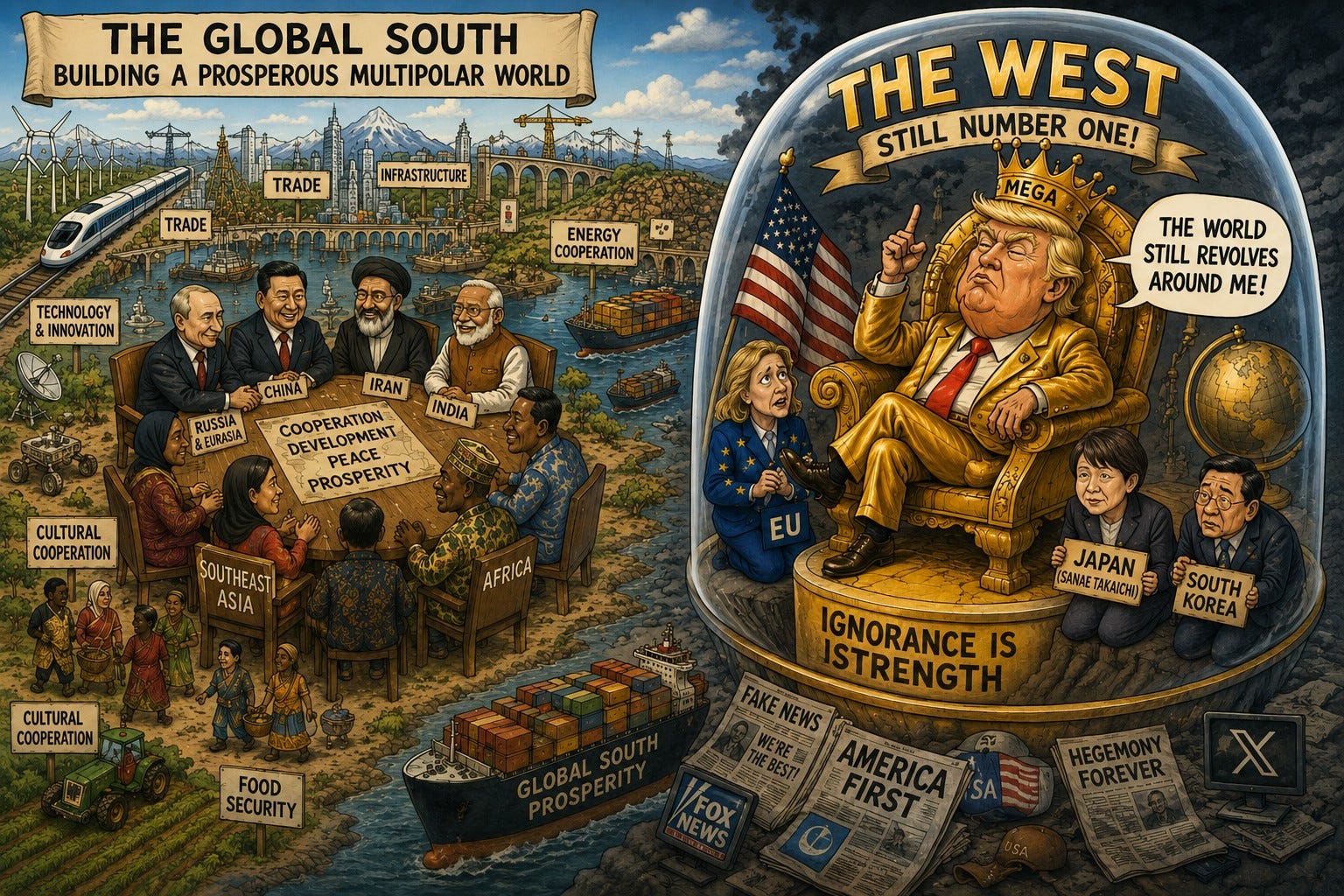
Dr. Jeffrey Sachs never ceases to amaze me.1 He recently gave one of his best summaries of the geopolitical mess we’ve gotten ourselves into, on one of my favorite venues. The hosts more or less sit back and let him run with the conversation, for 50 minutes or more. I encourage everyone to listen, if possible, but I also thought I would outline the basic points he covered, following.
We live in a weird media/financial bubble in which we are being told that “everything is going great”, and “we run the world.”
And yet, upon looking behind the curtain, at least two foreign policy crises are underway and out-of-hand. They each are manifestations of same essential problem; the Crisis of the United States and “the West.” For two long centuries—all of the 19th and most of the 20th—these countries have run the world. They no longer do so, and therein lies the problem: a crisis of power.2
The United States unilaterily declared itself the sole superpower, Madeleine Albright’s “indispensible nation,” following the 1991 collapse of the Soviet Union. But this unipolar moment passed quickly, and the belief that we continue to dominate the world in this manner is now the stuff of propaganda. And yet, in foreign policy, in politics, the media, and in day-to-day decisions, we remain programmed, acting to protect a hegemony that is no more.
This is actually a double crisis: our actions merely “utterly vulgar and self-defeating,” but those of the Europeans being inexplicably bizarre, as they act against their own economic and strategic interests, such as cutting themselves off from the very energy source which made their prosperity possible.
Why would Europe do this? Some say that it is simply that the Europeans do what the Americans say. Dr. Sachs, however, attributes it to their “imperial mentality,” the worst offender being Great Britain,3 which he fears will never lose it.4
This double crisis—the end of the Western-led world, and more specifically the end of the American-led world—is not a crisis at all for everyone else. On the whole, multipolarity is utterly benign or outright beneficial.
China’s rise is actually a good thing for our living standards. A major civilization, after suffering 130-140 years of humiliation under the hands of European and Japanese imperialists, is now back. This is good for the world.
The fact that Russia has emerged from the complete disarray following the collapse of the Soviet Union is also a good thing. At 17 million square kilometers, this giant country is a civilizational force, with a deep culture, just as China. It is a major source of technology. The fact that Russia is now prosperous and able to thrive is a good thing for the world.
But for the West, foreign policy is a zero-sum game. The idea of inter-connection between peoples, that the world is a positive-sum game where world trade should be mutually beneficial, where enjoying each other’s culture is advantageous, etc. is NOT the mindset of the “collective West.” The worst offenders, in Dr. Sachs’ eyes, are the Anglo-Saxons, who have spent the last few centuries viewing the world as us vs. them.
The angst of the political class manifest itself in a couple of ways. First, you can never disclose the weakness that is apparent for everyone to see. Everything must be expressed in grandiose terms: “we have won…we are in control…Ukraine is winning the war…we have defeated Iran…we’ve got China cornered…China is about to collapse,” etc. At all costs, multipolarity cannot be admitted. And if you do, you have to immediately explain how you’re going to prevent it from unfolding because, well, that would just be terrible.
The second point is that almost nothing being said by our governments is the least bit truthful; what is being said bears no recognizable connection with the realities that are now present. This is a geopolitical bubble; we are talking ourselves into the idea that the Western-led world still exists and all we have to do is to wait–out Trump, etc. Such policy is become more and more unhinged, day-by-day. The general public knows better. This is not a rampant happy-nationalism. Rather, “the public is being dragged along in amazement and dismay by a political class which has talked itself into these political and economic bubbles.”
Dr. Sachs then reviews a recent article in Foreign Affairs, the mouthpiece of the American foreign policy political establishment. He categorizes most articles in the publication as variations of we’re still number one. The article addressed the 5 possible ways that the future could play out:
Multi-polarity, which the author simply dismissed out of hand. He saw a dystopian world where there were no rules, no fixed alignments, a Hobbesian world of war by all against all. If the author were to actually look at the multipolar world as it exists right now, he would see that the source of disregard for rules, the source of contempt for international bodies, etc. is actually centered in the very country (us) that is seeking to maintain global hegemonic control.
Spheres of Influence, where each great power governs its own neighborhood and the United States retreats to the Western Hemisphere. The author also dismisses this option, as it would be seen as a “retreat.”
A Great Power Concert, in which the major capitols produce a managed peace. The author dismisses this possibility by noting that the Great Powers cannot even agree on climate change. (Dr. Sachs notes that it is the U.S., not the multi-polar Global South, that walked out of the global climate agreement.) The author also concludes that we cannot cooperate in this way because it would be “less favorable to the economic and security interests of the U.S. and its current allies.” In short, we cannot cooperate because we might lose money.
Partial Chinese Pre-eminence, in which China’s sheer scale is acknowledged. The author concludes that this would be terrible because it would reduce the U.S. and its partners to fall down the scale into real estate, tourism and commodities.
Allied scale (escalation), a world organized against China is seen as the only plan that balances China.
In short, the writer of the FA piece says that we cannot have a multipolar war, that we cannot just rule our neighborhood, we cannot cooperate with other great powers as that might be financially disadvantageous, and we cannot recognize existing Chinese pre-eminence. All we can do is mobilize the world against China. Dr. Sachs finds these scenarios to be “the most bizarre ideas conceivable.” He describes this mindset as precisely the logic that was in place as western Europe sleep-walked into World War I.

Towards the end of the interview, Dr. Sachs expounded on Europe’s slide into the First World War, as well as their widespread prosperity on its eve. He finds no deep fundamental reasons for why the continent had to go to war against itself, other than the formation of two alliance blocks that finally clashed on an “unprecedented industrial scale.” Dr. Sachs believes there is even less reason for going to war today between the EU nations and Russia, or China. He faults Kaiser Wilhelm, in his foolishness, as bearing much of the responsibility for the war. Sachs notes, however, that China is not Kaiser Wilhelm, that China is not “pursuing a global aggressive strategy, and China is not saying we will replace the United States as hegemon.”
What China is actually saying is the same message that they have had since 1949:
You have really messed with us. For more than a century you invaded us repeatedly, you dismembered us, you colonized us. You will not do that again. China was impoverished by all this and now we want to live and prosper, and be creative members of a world economy.
This is the fundamental logic of Chinese foreign policy and economic policy.
If you look beyond our propaganda, it is difficult to see China as an aggressive military power. It has not fought a war since a one-month border clash with Vietnam in 1979. China does not go to war. China does not have an “overseas archipelago of military bases”, with a military base in Djibouti, and perhaps one in Cambodia; compared to the over 750 U.S. bases in 80 countries. So the idea that China is seeking to “take over the world,” or that this is some kind of battle for hegemony is either a) delusional rhetoric, b) paranoia, c) complete ignorance, or a toxic combination of all three.
Dr. Sachs notes the recent Shanghai Cooperation Organization (SCO) meeting in Bishkek, Tajikistan, and the upcoming BRICS summit. The SCO represents 42% of the world population, 34% of the world’s output measured to purchasing power parity. The G7, by comparison, represents 9% of the world’s population and 28% of the world’s output.
As Dr. Sachs puts it, these nations are prospering and trading with one another and advancing their technologies, and are not much bothered by the crazy stuff spewing out of the western peninsula of Eurasia (Europe). He notes that the alliance between Russia and China is not one of convenience, but of tremendously smart economic complementarity. The most natural economic partnership would have been between Germany and Russia, but that has been snubbed by the former. Instead, Russia, with its “vast resources and extraordinarily talented and sophisticated human skills and technological and mathematical and scientific skills” is poised to be enormously prosperous from its turn to Eurasia.
Dr. Sachs ends his talk with comments on Iran, and how our view of the country is so at variance with its reality. We portray them as fanatics stuck in the 11th-century. He notes that its civilization runs as deep as any, and in this context is one of the most sophisticated places in the world. The sanctions the U.S. has imposed on Iran have hurt, but just as in the case of Russia, have actually made it stronger. Finally, the weaponization of our monetary policy will not work in the end. Use of the dollar was convenient, but not essential. Iran and many other countries are now easily trading in their own currencies. So much for the economic D-Day trumpeted by the loathsome Scott Bessent.
Dr. Sachs ends on a hopeful note, observing that these are not wars that either the disgruntled American or European public wants, but rather a function of our entrenched political interests, the Deep State, as described by some. Europeans are not interested in a war with Russia, and Americans are not interested in a war with Iran or China; only the entrenched political elites. I would like to believe he is right on this.5
For the past 4 1/2 years, no public commentator has brought more clarity to my philosophy on geopolitics more than Dr. Sachs. My sentiments were already there; he simply articulated them in ways I could not, and has continued to do so ever since.
Dr. Sachs notes that it is not a crisis for everybody else, and should not be a crisis for us either.
Sergey Lavrov has begun referring to Great Britain as simply “Britain.” The “Great” originally referenced a geographical understanding, but nevertheless, the British remained the only country which self-anointed itself with the monikor. The point is that the country is long past the point of deserving the appellation, if, in fact, it ever did.
For example, a mayor becomes Prime Minister and the first thing he does is put on the imperial mantle and high-tail it to Kiev, as if this were the most important issue his country was facing.
Anecdotally, I am not sure that many British don’t hunger for a fight with Russia (with the U.S. being the tip of the spear, of course). Their Russophobia runs deep. Experientially, I am not sure that many Americans don’t hunger for a fight with China. This is madness, of course, but what else is new?
Very interesting.
But unfortunately the scenario promoted by China et all is based on the illusion of the ever-expanding growth of the industrial behemoth.
This essay and website describes the situation:
http://www.nottwoispeace.org/excerpt-two-is-not-peace
Also http://www.priorunity.org
I don't know where you're getting or generating your illustrations, but they're better than most syndicated political cartoons.