Inventing the West
to keep fear alive

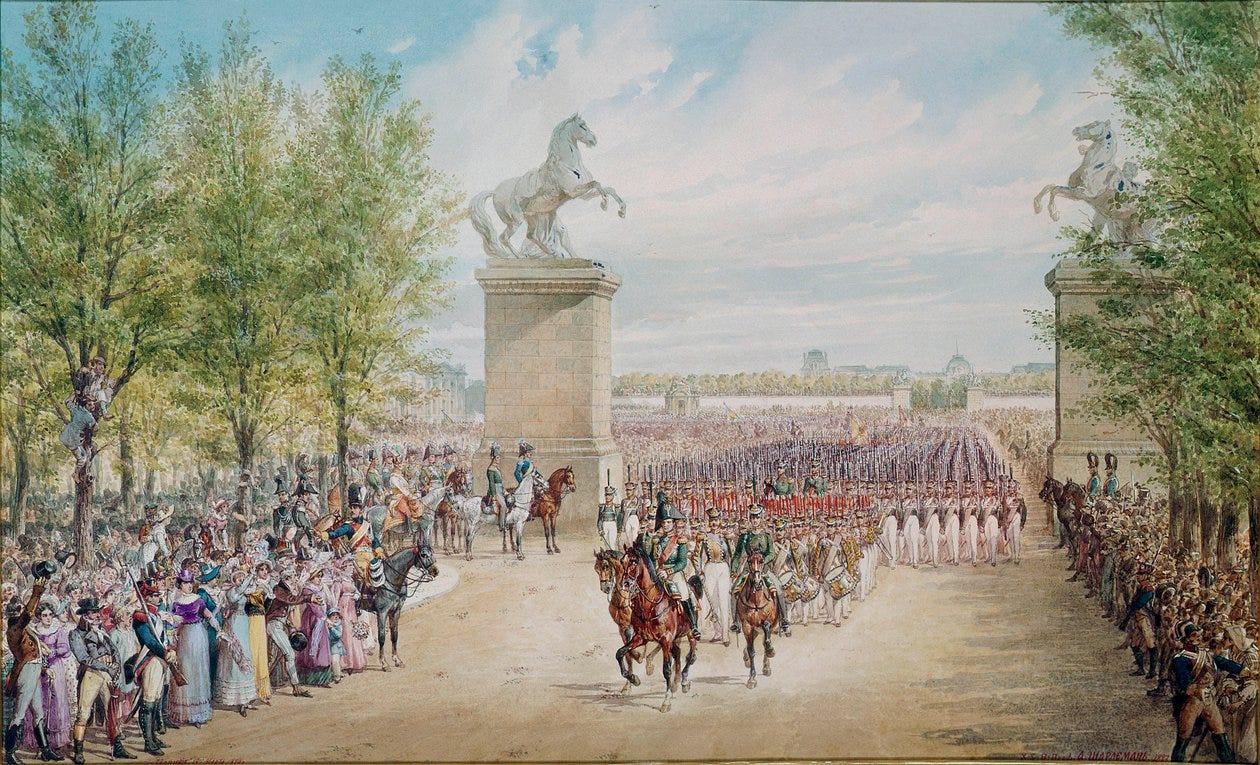
(This rather grand painting is by the improbably named Adolf Jossefowitsch Charlemagne.)
We have always been magazine people, stacks of them around the house in the way people used to live; from the wife’s Southern Living to journals reflecting my particular historical and literary enthusiasms. Today we have precious few, letting-go of subscriptions lasting decades. But through thick and thin, I retained subscriptions to the oh-so-pretentious London Review of Books and New York Review of Books. Each publication usually contained a book review of historical and/or literary interest to me. Back in the before time before the internet, it was a way of connecting to a world beyond East Texas.
I always knew the elitism was there–and no doubt, I bought into a little of it myself. The typical reader of the NYRB is ensconced in the Upper East Side, or wishes they were. In recent years this stance began to rub me the wrong way as I started paying attention to their editorials and extended essays on social issues and geopolitics. Much of our country seems incomprehensible-a great mystery-to the editors. America-between-the-Seaboards is certainly not incomprehensible to me (though, of course, that doesn’t mean I agree with that which I comprehend.) And so, I began to regret these subscriptions, finally determining to cut myself free.
My NYRB subscription will run its course in April. A recent issue was typical. An article by Diarmaid McCullough on the Virgin Mary confirmed my disinterest; while an article by Yuri Slezkine, reviewing Georgios Varouxakis’ recent The West: The History of an Idea, reminded me of why I had kept the subscription in the first place. But submissions like the latter are the exception, not the rule.
Varouxakis does not examine so much the composition of “the West,” but rather the historical development of the term; one which has no meaning at all without Russia. In an age when Japan and South Korea can be considered components of “the West”, the concept exists on something beyond a strictly geographical plane. Older classifications no longer work either. The term Christendom is a non-starter, mainly because a) most constituent states have abandoned their Christian foundation, and 2) Russia would have to be included, by extension. Use of the term Free World is no longer applicable, given the behaior of the primary players in the West today. Europe and/or Euro-American don not work either, for again, such terminology would not exclude the onion-domed East. So, “the West” must be simply that which is in contradistinction to Russia: in short, the Atlanticist coalition and their major allies; sometimes sloppily and incorrectly equated with the World.
The concept began to form after the defeat of Napoleon. We shorthand Napoleon’s defeat into the Russian winter and, in the British telling of the story, Wellington at Waterloo. But it not merely the Artic blasts which conquered the Grande Armée. It was Czar Alexander I who led the continent’s largest army in formation into Paris. This is Europe’s nightmare; an irrational one, to be sure, given France’s much closer neighbor given to bouts of “marching into Paris.” And if not for Czar Alexander, you would have been left with Napoleon. By the 1830s, various western Europeans began to voice their fear of growing Russian might–the genesis of Russophobia. The Marquis de Custine published his hatchet piece Russia in 1839, an easily discredited text that was being reissued in the 1970s as a reliable guide to dealing with the U.S.S.R.
But it was “the inventor of sociology, positivism, altruism, and the ‘religion of Humanity’”, who started the characterization of the West as a culture with a shared history. That man was Auguste Comte, and it was his British disciple, Richard Congreve, who first outlined a new European order without Russia. To Congreve, the Treaty of Vienna had outlived its usefulness. Ironically, given their own later history, German intellectuals also began to view Russia and “Cossack barbarism” with alarm—a threat to the new Germany. Germans have learned little, it seems, with Freidrich Mertz trying to rally today’s Germany to the eastern battlements. Nietzsche, however, contrasted the weakness and self-doubt of Europe with that brave, rebellious fatalism that still gives the Russians…an advantage over us Westerners in the way they handle life…the only power nowadays which has endurance, which can wait, which still has promise…the conceptual opposite of Europe’s pitiful petty-statery and nervousness.
Americans have always been apt students, and were not far behind their European schoolmasters. In 1897, Benjamin Ide Miller, after spending four years in Germany, wrote of a final showdown between the Orient and the “the Occidental idea.” What was this idea? It seemingly centered around individual rights and equal justice, which he contrasted against the “awful consistency” of Russia’s foreign policy–”ruthless of right, reckless of truth, framed on a plan that spans generations, conceived in terms of world-empire.” A British imperialist could not have said it better. I think it wise to pause a minute and reflect on this late 19th-century bit of Black Kettleism, for this was voiced during the height of the British Empire. If an objective person were tabulating the abuses of empire during this time, I am afraid the British Empire would far outpace that of the Russian.
These ideals have now morphed into human rights and democracy, the skeleton supporting the ideology of liberal democracy. Some remain skeptical of the project. One commentator put it thusly:
...the message remains familiar: a belief that one worldview possesses the right to correct, discipline, or reshape others. Beneath the polished language of “rights” and “development” lies the same impulse to guide and govern, revealing continuity rather than rupture in the long history of Western claims to superiority.1
Overuse and misuse of these stock phrases by those justifying empire have stripped substance and meaning from the language; deployed by U.S. Presidents as long as I can remember. Another American scholar piled on with this: Russia…has loomed larger and larger in men’s minds, and the strange fascination which her power exercises in modern political life is due in no small measure to the anti-individualistic tendencies of her civilization.2
By the end of the twentieth century the idea of “the West” had congealed into European civilization + British and Iberian settler colonies - Russia. Most people agreed that it had grown out of classical antiquity and Latin Christianity, owed something to the Renaissance, the Reformation, and perhaps the Enlightenment, and stood for some version of liberalism. The opposite of this understanding was “the East” (inclusive of Easter Europe) + everything else not settled by Western Europeans, irrespective of cardinal directions. Of all the non-Wests, Russia was the “closest, largest, mightiest, and least obviously non-Western, requiring repeated acts of estrangement and boundary marking.” This made Russians no nevermind because, while some considered themselves Europeans, none claimed to be Western.
The shock of the Great War and the crisis of liberalism generated a steady stream of doomsday prophecies, none more popular or portentous than Oswald Spengler’s The Decline of the West (1918), which argued, at great length, that the once vigorous “West-European-American” culture, falsely linked to Russia as a result of the promiscuous use of the word “Europe,” had reached the “age of sterile senescence.”
Even so, the West survived conceptionally for several reasons. “Western Civ” courses at American universities were first crafted in support of “US belligerence in 1917.” By World War II, Walter Lippman coined the term “Atlantic community,” headed by Washington. He described this crossing of the Atlantic by the controlling power in western civilization to be one of the “greatest events in the history of mankind.” Then the Cold War consolidated the idea by placing Western Europe under U.S. military protection, as well as aligning it more thoroughly with political and economic liberalism. Jewish émigrés to the U.S., Hannah Arendt, Leo Strauss, Melvin Lasky and Michael Josselson, among others, refined and defined the doctrine.
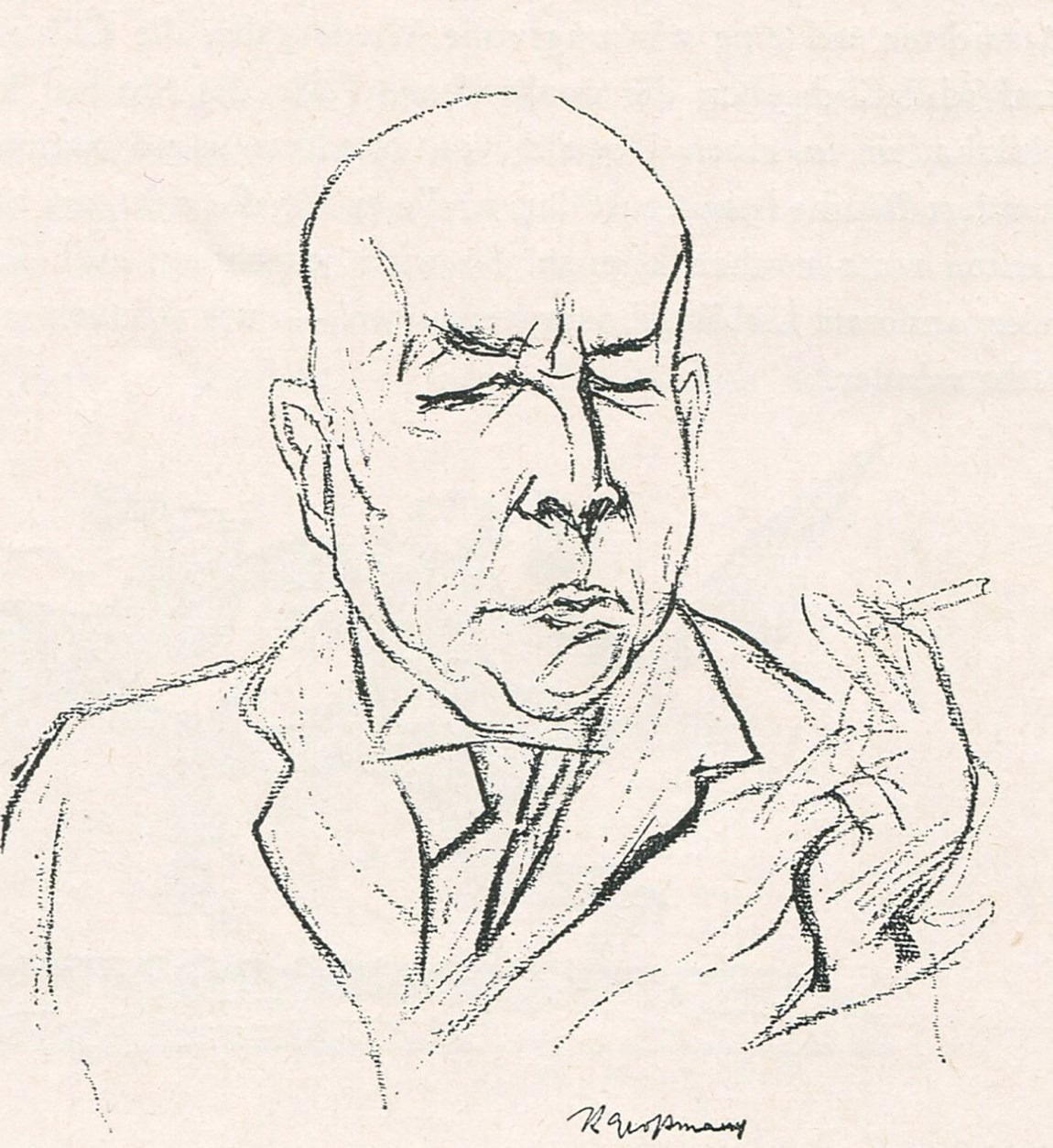
(Oswald Spengler; drawing by Rudolf Grossmann, from the German satirical magazine Simplicissimus, 1922)
But even these defenders of the West admitted that the greatest danger came not from the East, but with a fatal flaw in its own makeup, having been “born sick” and had been ailing ever since.
The “barbarization” of Europe in the twentieth century had been the result of “a gradual corrosion and destruction of the heritage of Western civilization,” Strauss wrote. The distinction between good and evil had been replaced by the distinction between progressive and reactionary. Progress was a function of history; history was too elusive to serve as a standard; hence “no standard whatever was left.” In Suicide of the West, published in 1964, James Burnham attributed the physical “contraction of the West” to a spiritual failing associated with “the decay of religion” and marveled at the “dazzling ingenuity” with which the “ideology of liberalism” managed to represent “defeat as victory, abandonment as loyalty, timidity as courage, withdrawal as advance.”
Varouxakis marshals a host of commentators on the subject:
Francis Fukuyama: the West’s present was everyone’s future (describing the itinerary as “getting to Denmark” and leaving no choice to those who’d rather stay where they are or go somewhere else).
Samuel P. Huntington: the West was “unique, not universal,” that it ended where Islam and Orthodoxy began, and that NATO should limit itself accordingly (with regard to Ukraine in particular).
James Kurth: the West had abandoned Christianity and liberalism, adopted an eclectic mix of human rights, multiculturalism, expressive individualism, and popular culture, and turned into a global anticivilization waging war on all traditional cultures, especially its own.
Michel Houellebecq: one possible outcome in his novel “Submission”: “Islam” means submission to God; “the West” means nothing in particular; the West’s future is submission to Islam.
William H. McNeill: in the “Rise of the West”...the largest community united by a “shared literary canon and expectations about human behavior framed by that canon. The advantage of this definition is that it introduces clear criteria; the problem is that “the West” no longer fits it.
Ultimately, a “pan-European revolution of cultural nationalization” had transformed “Christendom” into Europe + colonies, with “uncertain eastern boundaries.” This revolution fitted the political at the expense of the cultural. Hence, the West: a post-Christian Europe from the Atlantic to the Pacific, “a thin and fragile civilization but… a civilization nevertheless.” But, a “new magic spell” would be required.
“The West” was born with two congenital conditions, both diagnosed by Comte on day one: chronic aversion to Russia and the “continuous revolt of individual reason against the totality of human antecedents.” The first has to do with space, the second with time; the first with the limits of its domain, the second with the mystery of its origins. “The West” makes no sense without an antagonist in the East, and there is no better (worse) enemy than a false friend. Because its name emerged amid the ruins of a collapsed civilization as a code for its fractious heirs, the West appears to be in perennial decline. “Christendom” has a content, “Europe” has a shape, both had a past. The West remained to be defined.
On a philosophical level, America again came to the rescue with its Western civilization courses, the Blooms, and their canon of “great books.” The new order found martial expression in NATO, “an extension of American power into Europe posing as a mutual defense alliance.” Later still, the U.S. would pledge to defend the “Free World,” which was arrogantly presumed to equate with “the West.”
But actual history did not progress according to plan. The U.S.S.R. died “after a protracted battle with dementia.” Almost simultaneously, the West lost its way.
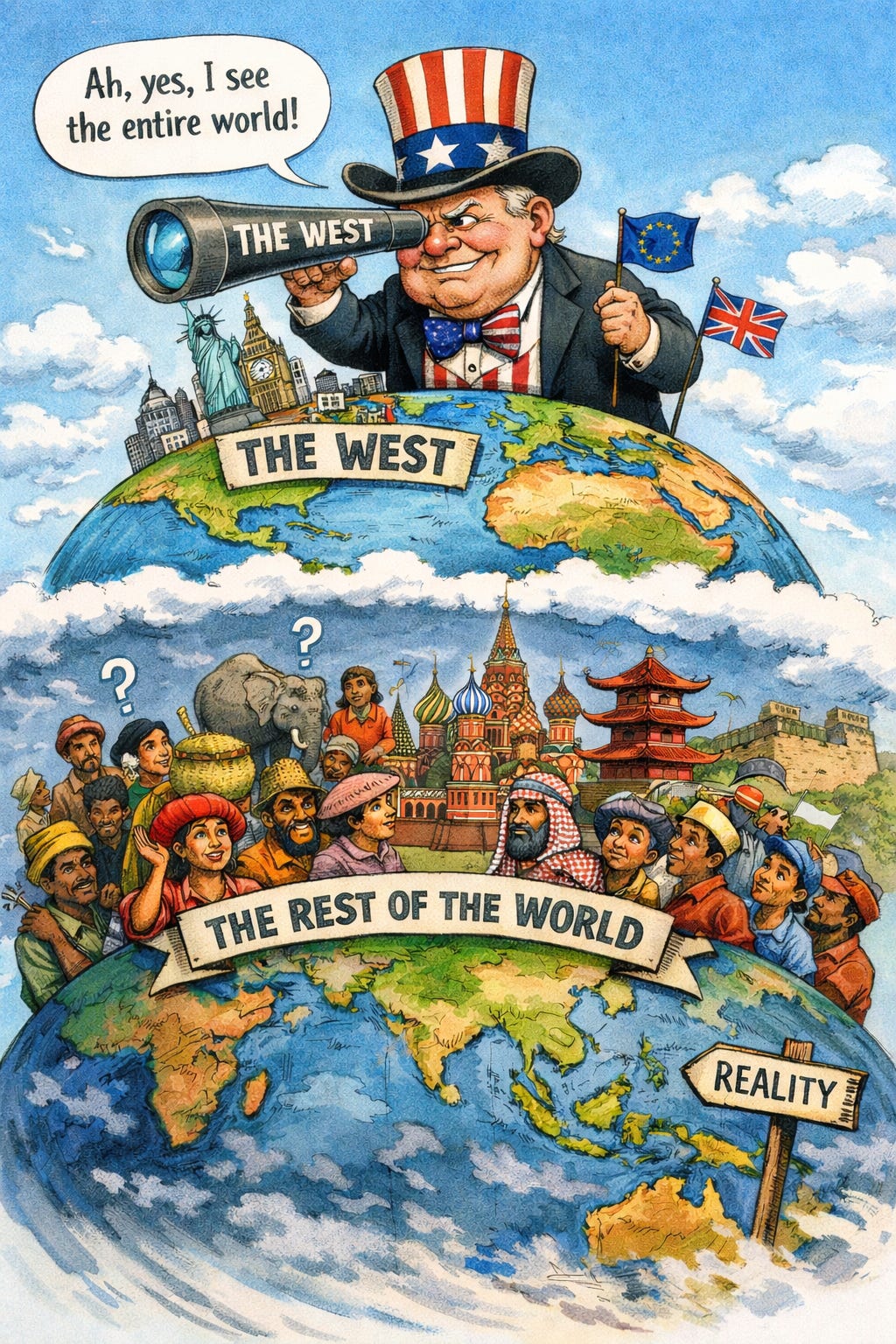
The collapse of communism coincided with the triumph of West-as-universal over West-as-unique, as the U.S. and its allies turned into “the international community.” The Free World became the World. World History courses replaced Western Civ, liberal democracy was extended to the rest of humanity as global human rights, universal “values” replaced any remaining Romantic raison d’êtres. “Western individualism, examined and deplored by Comte and his countless successors, gained new ground as liberated selves set about crafting ever more novel, pliable, and elaborately customized ways of being human,” as “schools, corporations, and government agencies committed themselves to transcending the division of humanity into men and women. Western civilization as a community…had ceased to exist because it no longer shared one. Western civilization as a cultural and political concept had ceased to exist because it had disappeared from political rhetoric, college curricula, and, in most quarters, cultural imagination.”
The West was still there, but its civilization was not…It was at this moment that NATO, a military institution Western in membership, anti-Soviet in design, and suddenly bereft of a mission, set about fulfilling its foundational prophecy. What mattered was not the nature of the engagement (war on terror, democracy promotion, humanitarian intervention, and struggle against autocracies are universal, not Western-specific campaigns) but whom it was directed against. The West was ready to reassert itself as post-Christian Christendom fearful of Russia. NATO, as the West’s military arm (the US empire’s European branch), needed the Russian threat to keep fear alive.
Varouxakis goes on at length, but the main point is clear; the West has defined itself in opposition to the Other. Whatever you may think of Russia, absolutely no one believes that they suffer any such constraints. Russian identity is foundational, not at all dependent on opposition to the West. The questions posed here are similar to those put to the shell-shocked Eurocrats at the Munich Security Conference last February by Vice-President Vance, and a month later at the Heritage Foundation: we know what you are against, but what, exactly, are you for? One thing is for certain, it will have to be something more substantial than “values.” Vance even suggests a rediscovery of the shared “single sacred language” that birthed a thousand-year civilization.
Constantine von Hoffmeister, “Eurosiberia,” substack.com, 11 January 2026.
This is by Paul Samuel Reinsch. I continue to be fascinated with the thread of Individualism that runs through the West, beginning no later than the Reformation. The belief in it is unquestioning.