Predestinated America
the fix was in from the beginning

In recent weeks I have read Max Weber’s The Puritan Ethic and the Spirit of Capitalism (1905). For this, I have to thank Jeff Rich, and the incredible resources he has assembled at Burning Archive. In an article here, he provides links to the entire book. I encourage you to check out the piece—he even provides an audio voice-over, in his soothing Australian accent.
Weber’s thesis is often short-handed as the Protestant Work Ethic, though he never used that exact wording. I have always referenced it in my history classes when explaining the Puritans of New England, and their out-sized influence on our country. But up until now, I had never actually read the book itself, an unpardonable oversight on my part. His work is deep and searing, seminal for understanding the foundations of this country, if not all Protestant cultures.
This is a poignant time to be reading the book, in the run-up to our 250th anniversary (a short history, as countries go). To begin with, I have always been ambivalent about July 4th, for a variety of philosophical,1 personal,2 and familial reasons34–all best relegated to the footnotes. But beyond that, in light of American history of the last few decades, and specifically what we are engaged in at this very moment leads me to question exactly what it is that we are celebrating. Perhaps sackcloth and ashes are more in order than flags rippling in the breeze. I will quietly note the date from afar.

But I understand that that is not the nature of our country. By and large, Americans remain blithely indifferent to the sufferings we are inflicting around the world, as we spread democracy one ballistic missile at a time. Some may counter that that is the behavior of our “leaders” (the Security State and its elected mouthpieces), and that the American people should not be held accountable. Perhaps. But this gives us a loophole that we do not allow those on the receiving end of our foreign policy: not necessarily leaders, but average Gazans, and Lebanese, and Cubans, and Iranian middle school girls, and the students in Russian dormitories.
So I imagine that this July 4th, our 250th, we can expect an explosion of propaganda about freedom, democracy, and liberty, in a land where these terms are rapidly losing any real meaning. But in a merely material (which is to say, deadened) sense, we have it okay, largely maintaining a just-believable semblance of continuity, if you will. And maybe we are allowed to ignore the obvious for one day. But at this point in our short history, I suggest that it would benefit us to take a long honest look at where we are now as a nation. Instead of blaming others, let’s drop the soothing propaganda, and concentrate on what we5 have done to ourselves at home.
And while we are at it, we should ask ourselves what in the Sam Hill we are doing to the rest of the world? What example are we setting? If we are “spreading democracy,” it is, at best, through destabilization and regime change, and at worst, at the tip of a ballistic missile. How many men, women, and children are dead or suffering on at least three continents—Ukraine, Russia, Iran, Gaza, Lebanon, Cuba? These conflagrations are not ones that we stumbled into, or rushed into to protect the innocent, but rather the calculated and purposeful projection of American power, based on the stated foreign policy of the United States.
I despair, of course, of any change short of our own defeat. But I do rack my brain trying to understand WHY? What was the fons et origo of this cancer in the American character that pushes us ever forward, maniacally never pausing, never satisfied or satiated, never reversing—bestriding the globe whether the world wants it or not? It is not a virtue, or something to be celebrated, but a fatal illness that will eventually devour us, as it has others before. Despite what Madeleine Albright said, we do not stand outside History.6
For historians, there are plenty of markers to note along our checkered history:
The trumped-up war of choice we are currently losing in the Persian Gulf will not end well (for us) and…
It should have been a non-starter to anyone with even the most rudimentary understanding of the region, and specifically our record over the last 25 years, which, of course, excludes the current Administration. But beyond that…
We totally misread the meaning and lessons of the end of the Cold War in 1991, which set the stage for all subsequent conflagrations, but…
The entire Cold War itself was not a shining moment for this country, the struggle being the natural outgrowth of the world we established at Bretton Woods in the summer of 1944, and yet…
The Second World War itself was teed-up by Wilson’s broken promise engagement in the First. Every possible post-war scenario based on our non-entry sounds infinitely better than what actually transpired, but it started even earlier with…
Our taste for international empire building from our war of choice with Spain in 1898, which was, in part, a continuation of…
The settlement of the West as a colonial enterprise, and…
The Monroe Doctrine of 1824, which was as much a ballsy reservation of the Americas for us as it was a No Admittance to Europe.
And so, on and on it goes on, marching back in time. Where to begin? I’m inclined to agree with Dr. Jeffrey Sach’s only half tongue-in-cheek conclusion that at the root of all world problems today, you find the British.

h/t to Louie Fourie
We are a polyglot nation today, but our beginnings and our institutions were solidly formed from the teachings we learned at the feet of the English. Indeed, we were their best pupils—the American Empire is in some ways simply the British Empire 2.0. But Canada (sans Quebec), Australia, and New Zealand are all British enterprises, formed from much the same stock as us. Why are these other British nations not as crazed as we are? Ah, here I think, we approach the root cause of our illness, for these other countries did not have a John Winthrop,7 and his City on a Hill.
Many say that slavery is our ancestral sin. I’m not so sure that it isn’t Puritanism.8 In fact, I can make a case for the outgrowth of Puritanism putting the wind in the sails of slave owners. Instead, I will lay two charges at the feet of the Calvinistic Puritans in America:
Avarice was refashioned as a virtue, and
Community was sacrificed to the solitary individual.
Weber explains both, so let’s dig deeper into the Protestant Work Ethic.
How the Puritans Ruined Everything (in a nutshell):
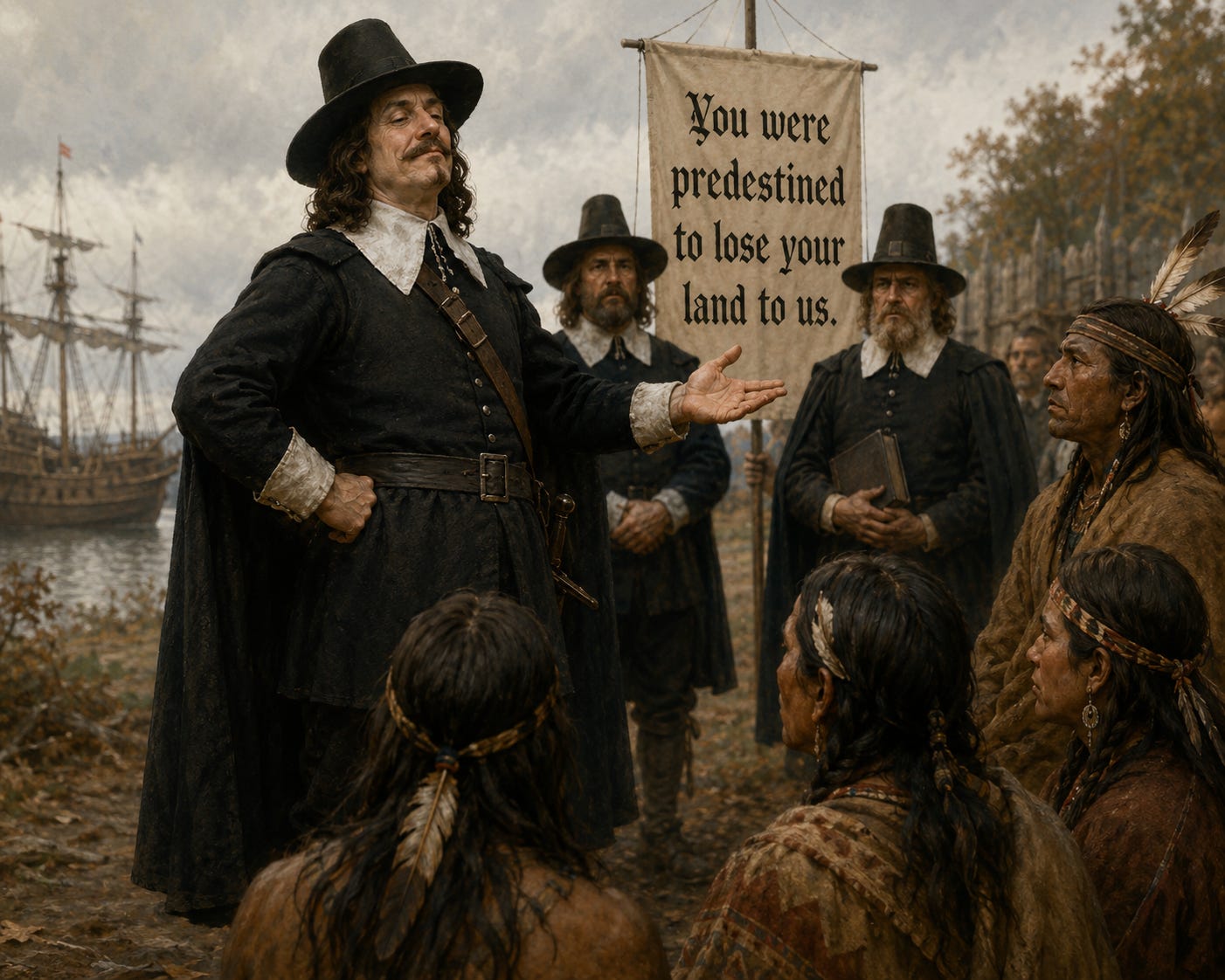
The sine qua non of Calvinism was their peculiar understanding of Predestination.9 The word does indeed exist, a time or two, in Scripture. But in over 1500 years, the Church never constructed an entire theological edifice upon this foundation. But to these novice Protestant interpreters of Scripture, no longer bound by the received teachings of the Church, the concept bespoke a sovereign God who had foreordained everything, and whose justice must be satisfied. Gone was the loving God of mercy, the Father in the Parable of the Prodigal Son, etc. Gone was the forgiveness inherent in the sacramental cycle of liturgical life. In its place, a wrathful God, in His sovereign omnipotence, had decreed the fate of every living thing, and there was simply nothing that any individual could do to add or subtract from this judgment.
This doctrine was as cold and unforgiving as concrete. If that was all there was, if everyone’s fate was already cut and dried, as it were, then the best response would be to simply live the best life, with as much enjoyment and pleasure as possible, for in the end, nothing you did really mattered. There certainly wouldn’t be any need to go to church, as it wouldn’t move the needle an iota. There would be no need for preachers to pound pulpits, and no need for anyone to show up to listen to them even if they did.10 In fact, at one point, Roger Williams did point that out to the Puritan establishment in Boston; to-wit, we have Rhode Island.
This was obviously not the path taken by the Puritans. In the sheer force of their convictions, they fashioned a determined and convoluted alternative response; managing to bend Reason into a full circle. Having cut themselves adrift from the teachings of the historic church, these Calvinists were left to their own devices. And to their credit, they did not shrink from it! But the question haunting them remained: in light of their absolute certainty in the sovreign predestination of every soul by God, then how was one to live their life in light of this?
These Calvinists, racked with doubt, longed for the same certainty of their election by God, as they placed in the certainty that defined their belief in Predestination. As Weber notes, they began with the premise that God showers his material blessings on His elect. (I find that a faulty premise, one not at all supported by Scripture, much less by reality. The wicked prosper easily.) As Weber noted, “God Himself blessed His chosen ones through the success of their labours…” So, if a Puritan worked really hard, saving and accumulating, and amassing the things of this world-“prospering”, as it were-then that would be proof of their election (as long as they did not seek to enjoy the fruits of this labor in anything that smacked of the sensuous enjoyment of life.) In this manner, the Puritan self-created the certainty (proof) of their salvation—and certainty was the watchword of their beliefs.
And so, concentrated, purposeful labor—the “getting ahead”—was exalted as proof of one’s election by God. Greed has ever been with us, in all places and all times; but this hunger for money had always been called for what it was: avarice. Calvinism, combined with Luther’s concept of a calling in life, ennobled this vice into a virtue. Indeed, it became the way in which one served the Lord-the duty of the individual toward the increase of his capital, which is assumed as an end in itself…not simply a means of making one’s way in the world, but a peculiar ethic…an ethos. Weber describes this as a new Christian (Protestant) asceticism.
The source of the utilitarian character of Calvinistic ethics lies here…the doctrine of predestination. In practice this means that God helps those who help themselves. Thus the Calvinist, as it is sometimes put, himself creates his own salvation, or, as would be more correct, the conviction of it…There was no place for the very human Catholic cycle of sin, repentance, atonement, release, followed by renewed sin. Nor was there any balance of merit for a life as a whole which could be adjusted by temporal punishments of the Churches’ means of grace.
In short order, real virtues became redefined solely by their value to the accumulative process, such as in many of Benjamin Franklin’s utilitarian axioms. Franklin was an old rascal, but he was raised Puritan in Boston, and the belief system permeated most everything he wrote. Here we see the seedbed of the hypocrisy that the rest of the world often sees in us. We portray ourselves as upstanding and virtuous, while often our virtues are simply covers for own aggrandizement. We have an extremely long history of promoting “democracy” in a struggling or weak country as a means of appropriating their resources. (if this is a novel concept, you can start out easy, with our colonization of the American West, then move on to the history of Hawaii in the nineteenth century, and then look south of our border where you will find examples in every nation.)
If this behavior were confined to a cluster of religious zealots in New England, it would be nothing more than a sociological and historical curiosity. But the aggressive behavior of appropriation and acquisition became unmoored from its quasi-religious underpinnings and took on a life of its own. In short order, this became the template for American aggressivness in the accumulation of land, wealth, and capital, first here and then abroad.
Protestant theological tenets were fresh and new—untested by time, as it were. And I think we can objectively say that Predestination as a foundational belief system simply failed the test of time. It worked in the red-hot zealotry of the initial generations, whether in Geneva, Holland, Edinburgh, or New England. But one of the paradoxes of Protestantism is that association held on mutually agreed-upon intellectual constructs proves hard to maintain over the long haul. Succeeding generations of Puritans simply fell away from religious Puritanism. New England Congregationalism was still the social glue that held the region together, but the religious enthusiasm had faded. In time, these foundations either sloughed away, or were kicked free by the younger generations, leaving only the ingrained behaviour of the accumulative process remaining, now a good in its own right, apart from demonstrating any election by God.
That anyone should be able to make it the sole purpose of his life-work, to sink into the grave weighed down with a great material load of money and goods..[was] the product of a perverse instinct…
But out of this flowed what Weber described as the social ethic of capitalistic culture. The resulting economy gave birth to an immense cosmos…which…forces the individual…to conform to capitalistic rules of action. Weber finds greed and unscrupulousness in Catholic cultures as well, but their avariciousness was never formed into an ethos. Finally, Weber notes that traditionalism was the most important opponent to the spirit of capitalism.
Finally, I have always viewed American individualism with skepticism. Individuals do not build societies and create human flourishing; communities do that work. Weber credits this to the Calvinists as well.
One consequence was a feeling of unprecedented inner loneliness of the single individual…the most important thing in life, his eternal salvation, he was forced to follow his path alone to meet a destiny which had been decreed for him from eternity.
No priest could offer mediation. There were no sacraments by which the believer encountered God. There was not even a church, for churches contained both the elect and the damned. The latter were there, not to attain salvation, since this was impossible, but rather forced to obey the commandments of God for the glory of God. Finally, even God abandoned the Calvinist believer, as he must prove his election by his labor.
This thankfulness for one’s own perfection by the grace of God penetrated the attitude toward life of the Puritan middle class, and played its part in developing that formalistic, hard, correct character which was peculiar to the men of that heroic age of capitalism.
And there we have it. Does Puritanism explain everything about America? Of course not, but it does explain a lot.
Of course, July 4th and every American holiday has been weaponized these days; devoted to supporting our troops who “protect our freedoms”—wrap that eagle in a flag, and turn up the Lee Greenwood (and I will note, that his signature song bothered me from the very beginning, even in those emotional fraught times.) That these freedoms are protected largely by blasting people who pose no threat to us is never explained. I would support our troops by keeping them out of harm’s way, but what do I know.
I recently scolded a friend for a bit of overt political partisanship. He does not hold to my view that politicians are whores, the only differentation is not between red or blue, but the price they command. He characterized me as being “anti-sport” and not a team player. I thank him for this bit of crystal-clear analysis, for I am most decidedly not! And so, I have always stood back a bit from all the hoopla of the crowd every July 4th.
Feeling disconnected from July 4th goes all the way back for me. I learned it naturally, as my family was not overtly patriotic in the usual sense—no flags, no firecrackers, no parade-watching. Dad usually had hay on the ground about that time, which overrode any holiday plans. But there was usually my mother’s fried chicken and homemade rolls, and a watermelon. Their calm, dispassionate love of place, rather than patriotic exuberance has served me well. This has also kept me from getting too twisted-off into the dead-end of political alliegances.
As a 12 or 13-year old boy, I remember my mother and her brother-in-law (an uncle I have always idolized) having a discussion about the flag. He was a career Navy man and had traditional views on the flag and patriotism. My non-sentimental mother was having none of it. She replied that it was “just a piece of cloth.” Now that is anti-sacramentalism taken to the extreme, but in this case, concerning the talisman of mere nationalism and patriotism, I feel she was more right than wrong.
Not Iran, not Islamoterrorism, not China, not Russia, not the North Koreans, not any Axis of Evil, not the Communists, not the Cubans or the Venezuelans, etc.
“…America; we are the indispensible nation. We stand tall and see further in the future than other countries.”
Winthrop was a leading Puritan, founded Boston in 1630, and preached the foundational sermon, “City on a Hill.”
Critics will counter with the fact that the Puritans emphasized education, and established Harvard and Yale. Really? That is your defense?!
Westminster Confession of 1647: Chapter 111, No. 3. By the decree of God, for the manifestation of his glory, some men and angels are predestined unto everlasting life, and others foreordained to everlasting death.
As inherently obvious as this may be, one should not undertake to debate a Calvinist. In a former life, I overheard a conversation in the foyer of a fundamentalist church. The hot-shot Youth Minister was talking to my friend, the late, great Milton Burton, a commited Calvinist. The conversation went like this:
YM: You believe in predestination, don’t you?
MB: Indutably.
YM: I don’t believe that way.
MB: That’s because you were predestined not to.
All arguments with Calvinists are variations of this one.
You might appreciate Phillip Cary’s essay, WHY LUTHER IS NOT QUITE PROTESTANT, Pro Ecclesia Vol. XIV, No. 4. He deals extensively with how Luther and Calvin differ on predestination, and where Calvin’s doctrine leads. His conclusion is similar to yours, though not expressed in terms of American imperialism.
The closing conversation reminds me of the Middle Eastern story of the servant who was caught stealing from his master. When his master started to beat him, he said "Please, please, master, do not beat me! It was my destiny to steal from you." Whereupon the master replied, "And mine to beat you for it."